ICEEPSY 2025
ICEEPSY 2025
|
|||
|
You are warmly invited to join ICEEPSY 2025, the 16th International Conference on Education and Educational Psychology, taking place 03–05 November 2025 in beautiful Antalya, Türkiye, and online.
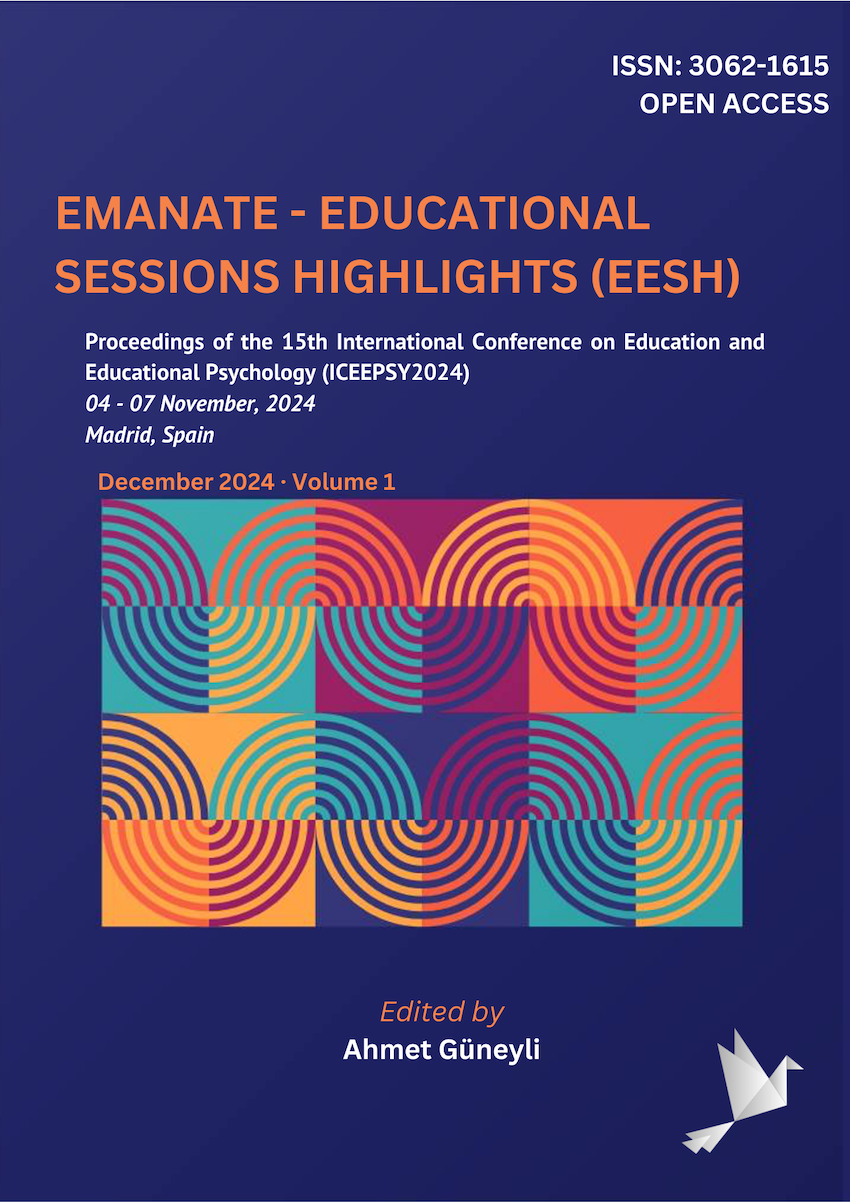
ICEEPSY 2025 will bring together students, teachers, researchers, practitioners, psychologists, and international scholars for three days of symposiums, workshops, presentations, academic exchange, and professional networking. This year’s conference will place special emphasis on emerging developments in AI and education, including AI-powered pedagogy, ethical and responsible AI in education, AI-enhanced classroom tools, assessment and evaluation with AI, inclusive education, curriculum design, educational research, policy and governance, student engagement, student support, educator professional development, lifelong learning, and emerging AI trends in education. Since its establishment, ICEEPSY has welcomed more than 6,640 participants from over 91 countries. The Academics Institute Scientific Committee and Board of Reviewers are working diligently to maintain the high academic standards and international quality of the conference. ICEEPSY 2025 Proceedings will be published in Emanate - Educational Sessions Highlights (EESH). Once published, it will be submitted for evaluation and possible coverage in Web of Science Core Collection™ Conference Proceedings Citation Index - Social Sciences & Humanities (CPCI-SSH) and abstracts will be published in the Abstract Book ICEEPSY (ISSN: 1986-3020), a serial publication registered with the International Centre for the Registration of Serial publications in Paris.
We look forward to seeing you in Antalya, Türkiye and online in November 2025. |
|||
|
|
Zafer Bekiroğulları |
|
Benedict du Boulay |

Invited Speakers & Symposium Speakers |
 |
|
| Benedict du Boulay, Emeritus Professor, University of Sussex, UK |
| Benedict du Boulay is a distinguished British computer scientist and former secondary school teacher now specializing in artificial intelligence in education and the psychology of programming. He holds the position of Emeritus Professor at the University of Sussex and serves as a visiting professor at University College London. His research focuses on understanding how novices learn programming and applying AI to educational contexts, particularly in enhancing students' metacognitive skills and motivation. He has authored or edited numerous publications, including "AI for Learning" (2022) and the "Handbook of Artificial Intelligence in Education" (2023). |
| About Keynote Speech |
| One of the most important outcomes for an educational institution is that its learners get better at “doing” learning. This talk explores the way that artificial intelligence systems and human teachers blend their efforts to achieve this outcome. Central to “learning to learn” is the skill of self-regulated learning where the learner focuses on the processes of their learning in addition to the content of that learning. These processes include planning, goal setting and reflection not just in terms of meta-cognition, but also in terms of their meta-motivational and meta-emotional facets. The division of labour between the artificial intelligence (AI) systems and the human teachers can be blended broadly in three ways: The AI system acts as both content teacher as well as promoting self-regulated learning. This involves the human teacher introducing the AI system into their teaching and then priming and motivating the leaners into using it effectively. The AI system then (i) adaptively chooses learning tasks, (ii) gathers and analyses learner data as the learners work on those tasks, (iii) adaptively reacts to how well the learners progress on the tasks, and crucially (iv) adaptively reacts to the way the learner has gone about their learning. Finally handing back to the human teacher a summary of how things have gone for the teacher to provoke whatever discussion is then needed. The AI system acts as content teacher but simply gathers and analyses data on learning and self-regulated learning. This is similar to the blend described above except that step (iv) “adaptively reacts to the way the learner has gone about their learning” is omitted and the system periodically pauses and hands over the analysed learner data during the lesson to the human teacher to provoke whatever discussion is then needed. The AI system does not interact directly with the students but but simply gathers and analyses data on the learners’ learning and self-regulated learning which it then hands over to the human teacher and/or the learners for discussion. This talk will discuss all three of the above blends with examples. |
 |
|
| Richard Lee Davis, Asst. Prof. EPFL - Swiss Federal Technology Institute of Lausanne, Switzerland & KTH Royal Institute of Technology, Sweden |
| Dr. Richard Lee Davis specializes in technology-enhanced learning and computational modeling in education. As an assistant professor at KTH and a former co-director of the EPFL-ETH Zurich Doctoral Program in Learning Sciences, his work bridges research in AI-driven educational systems, human-computer interaction, and the practical implementation of orchestration graphs for scalable learning environments. |
| About Keynote Speech |
| Education faces an existential crisis triggered by the emergence of generative AI tools in schools and classrooms. Students report frequently using these tools to make their work more efficient, but this efficiency comes at a cost: students offloading their thinking to GenAI tools can result in reduced learning and harm academic performance. The effects of cognitive offloading have been observed across various educational levels, from K-12 to higher education. Two paths forward are emerging, each leading to a distinct transformation of schooling. One path is concerned with guarding existing learning activities and assessments against the use of GenAI. The primary motivation is to preserve methods that reliably support learning and that large parts of the schooling system are built around. While well-intentioned, this approach may lead to a future where students are increasingly surveilled and treated with distrust. The other path embraces change by letting go of the things that GenAI can do well. Instead of defending essays and quizzes, this path searches for alternative activities to support learning. My research explores this second path. I will present evidence that constructionist pedagogy—experiential, project-based, creative, and student-directed—is particularly well-suited for post-GenAI schooling. My research demonstrates that constructionist learning activities can achieve specific learning goals while motivating students and fostering autonomy. I will also share work on designing GenAI tools that integrate naturally into these environments without short-circuiting learning. Finally, I will discuss the challenges of enacting these pedagogies at scale and describe how GenAI and multimodal learning analytics may help address them. |
|
 |
SSS I |
|
| Benedict du Boulay, Emeritus Professor University of Sussex, UK |
Qi Zhou, Phd University College London, UK |
| Learning to learn: Supporting the affective facet of learning to learn | AI-Driven learning analytics for equitable and reflective collaborative learning |
| About Speech | About Speech |
| Many AI systems have supported the affective facet of learning and some have also attempted to support the affective facet of self-regulated learning. This talk will describe three kinds of AI system. Purely Reactive systems try to recognise the learner’s affective state and react to it in a way that is hoped to be helpful: for example, by reinforcing a presumed, positive state through praise (say) or by empathising with a presumed, negative state. Such systems will have a limited effect on the learner’s affective self-regulatory capability. Explicit systems both react to and name the inferred affective state of the learner. Identifying the affective state to the learner and suggesting how to deal with it during learning should develop the learners’ accuracy in identifying and managing such states. Pro-active systems specifically engage learners in affectively focused activities during learning to help them learn to manage their affective states both negative and positive. | This symposium will present how AI and learning analytics can support equitable, reflective, and effective collaborative learning. Drawing on work in AI-driven educational tools, machine learning, language models, and learning dashboards, the presentation will explore how student discourse can be used to identify challenge moments, support self-, co-, and socially shared regulation of learning, and provide evidence-based feedback for reflection. It will also address the role of teachers in orchestrating multi-group collaborative classrooms, with a focus on designing AI systems that strengthen teacher-AI collaboration while preserving teacher agency. The symposium will further discuss how AI-informed classroom practices can respond to the needs of diverse learners and learning environments. By connecting technological innovation with pedagogical purpose, it will highlight practical ways to use data, reflection, and teacher insight to improve collaborative learning experiences without reducing the central role of educators. |
Workshops |
|
|
 |
Rethinking Learning and Assessment with AI
|
|
| Richard Lee Davis, Asst. Prof. EPFL - Swiss Federal Technology Institute of Lausanne, Switzerland & KTH Royal Institute of Technology, Sweden & Victoria Abou-Khalil, PhD EPFL - Swiss Federal Technology Institute of Lausanne, Switzerland |
|
| About Workshop | |
| AI can now write essays, solve problem sets, and pass exams; all tasks that are central to student learning. This is often framed as an existential threat to education. Yet this disruption creates an opportunity to revise learning goals, redesign activities to be more authentic and meaningful, and rethink assessments. This workshop applies the principle of constructive alignment to the challenges and opportunities posed by AI. In domain-based groups (e.g., mathematics, writing), participants will begin by revisiting intended learning outcomes: Which should be preserved, which could be removed, and which new ones might become possible with AI support? Building on this, groups will brainstorm novel learning activities that use AI to enable more sophisticated and authentic tasks, while remaining focused on meeting learning outcomes. We will then move on to the question of how to assess learning outcomes in ways that remain equitable, fair, and valid. The workshop will conclude by drafting a set of preliminary recommendations or a framework for inclusive, AI-enabled learning and assessment, laying the foundation for future collaborative work and potential publication. | |
 |
|
| Jason Gold, Assoc. Prof. Dr., Sagami Women’s University, Japan |
| About Workshop |
| This interactive workshop helps participants recognize barriers to creativity and explore practical strategies to overcome them, with direct applications for both instructors and their students. Grounded in research from educational psychology, positive psychology, and related fields, the workshop also integrates insights from creativity studies, time management, and emerging work on AI in education. The session highlights five or more common obstacles to creativity—including fear of failure, fixed mindset beliefs, lack of diverse input, mental overload, overreliance on AI, and limited energy or focus. For each barrier, participants will be introduced to research informed strategies such as reframing mindsets, broadening perspectives, offloading routine tasks, and using AI critically rather than passively. Participants will actively engage in multiple short group discussions, sharing their own experiences and reflecting on how the strategies can be realistically adapted to their teaching and professional contexts. By the end, attendees will leave with concrete tools they can immediately implement to foster creativity in classrooms and personal work, while also renewing their own creative practices. |
ICEEPSY 2025 Program
DAY 1
Monday, November 03
|
13:00 – 14:00 |
Registration (Hotel Lobby) |
||
|
The Conference Registration and Information Desk will be located in front of the Hotel Lobby and will be open between 13:00 to 14.00. Registration is not available after November 03, 14.00. For those wishing to pay on the day, please note that we will be able to accept cash payment in GBP and EUR only, however, we cannot accept payment in foreign currencies. |
|||
|
14:00 – 14:15 |
Opening Ceremony |
||
|
14:15 – 15:15 |
Keynote Speech |
||
|
|
Learning to Learn: The Blended Roles of Human Teachers and Artificial Intelligence Systems |
||
|
15:15 – 15:45 |
Coffee Break |
||
|
15:45 – 17:15 |
Workshop I |
||
|
|
Rethinking Learning and Assessment with AI Workshop leaders: Asst. Prof. Richard Lee Davis, EPFL - Swiss Federal Technology Institute of Lausanne, Switzerland & Dr. Victoria Abou-Khalil, EPFL - Swiss Federal Technology Institute of Lausanne, Switzerland |
||
|
17:15 – 17:45 |
Coffee Break |
||
|
17:45 – 18:45 |
Oral Presentation Session I |
||
|
19:00 – 20:00 |
Welcome Cocktail |
||
DAY 2
Tuesday, November 04
|
11:30 – 12:30 |
Keynote Speech |
||
|
|
How AI is Breaking Education (and Why That Might Be a Good Thing) |
||
|
12:30 – 13:30 |
Lunch |
||
|
13:30 – 15:00 |
Symposium on AI and Learning |
||
|
|
Theme: A Multimodal AI System for Real-World Collaboration and Regulation of Higher Education Students: Lessons Learned |
||
|
15:00 – 15:30 |
Coffee Break |
||
|
15:30 – 17:00 |
Workshop II |
||
|
|
Overcoming Barriers to Creativity: Research-Based Strategies for Teachers and Students in an AI World |
||
|
17:00 – 17:30 |
Coffee Break |
||
|
17:30 – 18:50 |
Oral Presentation Session II |
||
|
19:00 - 19:15 |
Poster Presentation Session |
||
DAY 3
Wednesday, November 05
|
10:30 – 12:30 |
Workshop |
|
Title: TBA |
|
|
Workshop Leader: Ann-Katrin Sward |
|
|
12:30 – 14:30 |
Farewell Gathering |
|
An informal opportunity to meet together on the final evening of the conference at the hotel bar area and exchange ideas for next year. |
|
|
For more information, please see the detailed program. |
|
ICEEPSY 2025 Publication |
|
|
|
Conference Proceedings |
|
If your abstract had been accepted, and you presented your work at the conference (including Virtual Presentations), you are encouraged to submit a full paper for inclusion in the Emanate - Educational Sessions Highlights (EESH) published by Emanate Publishing House Ltd. Once published, it will be submitted for evaluation and possible coverage in Web of Science Core Collection™ Conference Proceedings Citation Index - Social Sciences & Humanities (CPCI-SSH) and indexed in Google Scholar. The ICEEPSY 2024 Conference Proceedings will be published online in a PDF and Epub format and will be available in digital format. |
Publication
For further information about on submission and review process, please visit ICEEPSY 2024 Abstract Submission Process.
The publisher follows Gold Open Access as publication model. Publication fee will be covered by the conference organizers. There will be no extra cost for authors for publication.
The ICEEPSY 2024 Proceedings will are available through “Gold Open Access” and bear Creative Commons License, CC BY-NC-ND license. In this model, the articles are immediately freely available online immediately and permanently for everyone to read, download and share. The copyright of the papers will remain with the authors. for further details
Publication of the papers is predicated on the presentation (oral/virtual/poster) of the paper at the conference at the time slot stated in the conference itinerary.
For further details about peer review process, please refer to the link here and the reviewers should abide by all principles and suggestions outlined by the publisher here.